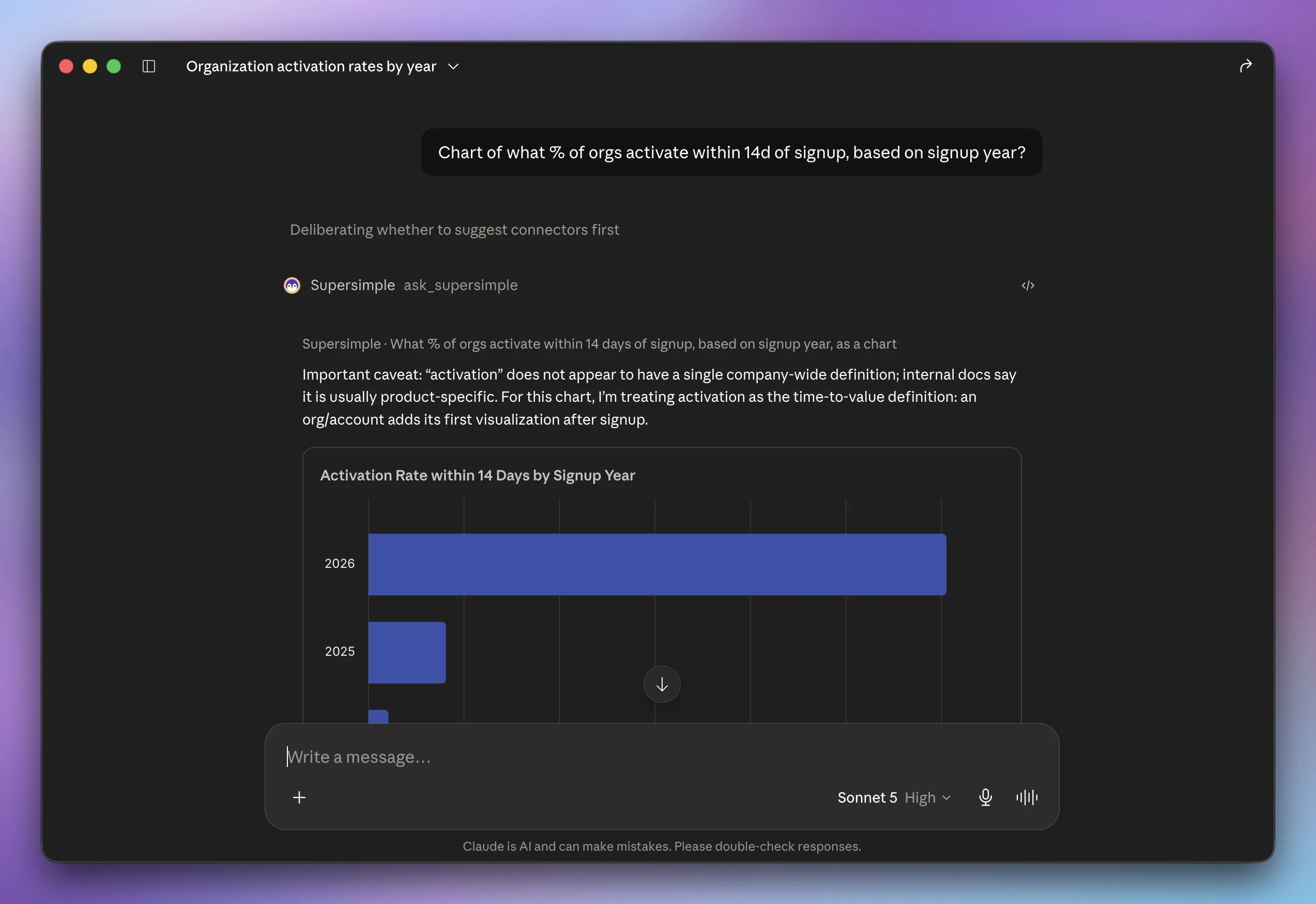
Where Claude works great
With a clear, bounded dataset, Claude can write correct SQL and create beautiful one-off visualizations that you can share with your team.
Claude is an excellent general-purpose chat. Supersimple adds context tooling, explainable logic, governance, collaboration, and a feedback loop for shared, repeatable analytics.
Trust requires more than an AI explanation written after the fact. Supersimple shows the actual models, relationships, filters, formulas, and aggregations behind every table and chart.
People can correct the work without rewriting SQL, collaborate on the same exploration, and keep it as a report, dashboard, or alert that can be maintained as the underlying data changes.
A language model can generate a plausible query quickly. Reliability depends on whether it uses the right entities, relationships, metrics, permissions, caveats, and company-specific terminology.
Supersimple centralizes that context for people working inside Supersimple and for agents starting from Claude, Slack, or another MCP client.
With a clear, bounded dataset, Claude can write correct SQL and create beautiful one-off visualizations that you can share with your team.
Supersimple preprocesses company knowledge before a question is asked, filtering low-quality content and structuring it for AI. Its custom search index enables fast, accurate retrieval with source permissions and precise filters for folders, paths, authors, channels, dates, and file types.
Without a centralized view, recurring problems remain scattered across individual conversations. Data teams cannot see which questions people are asking, where the data stack is incomplete, which assumptions agents are making, and what's going wrong.
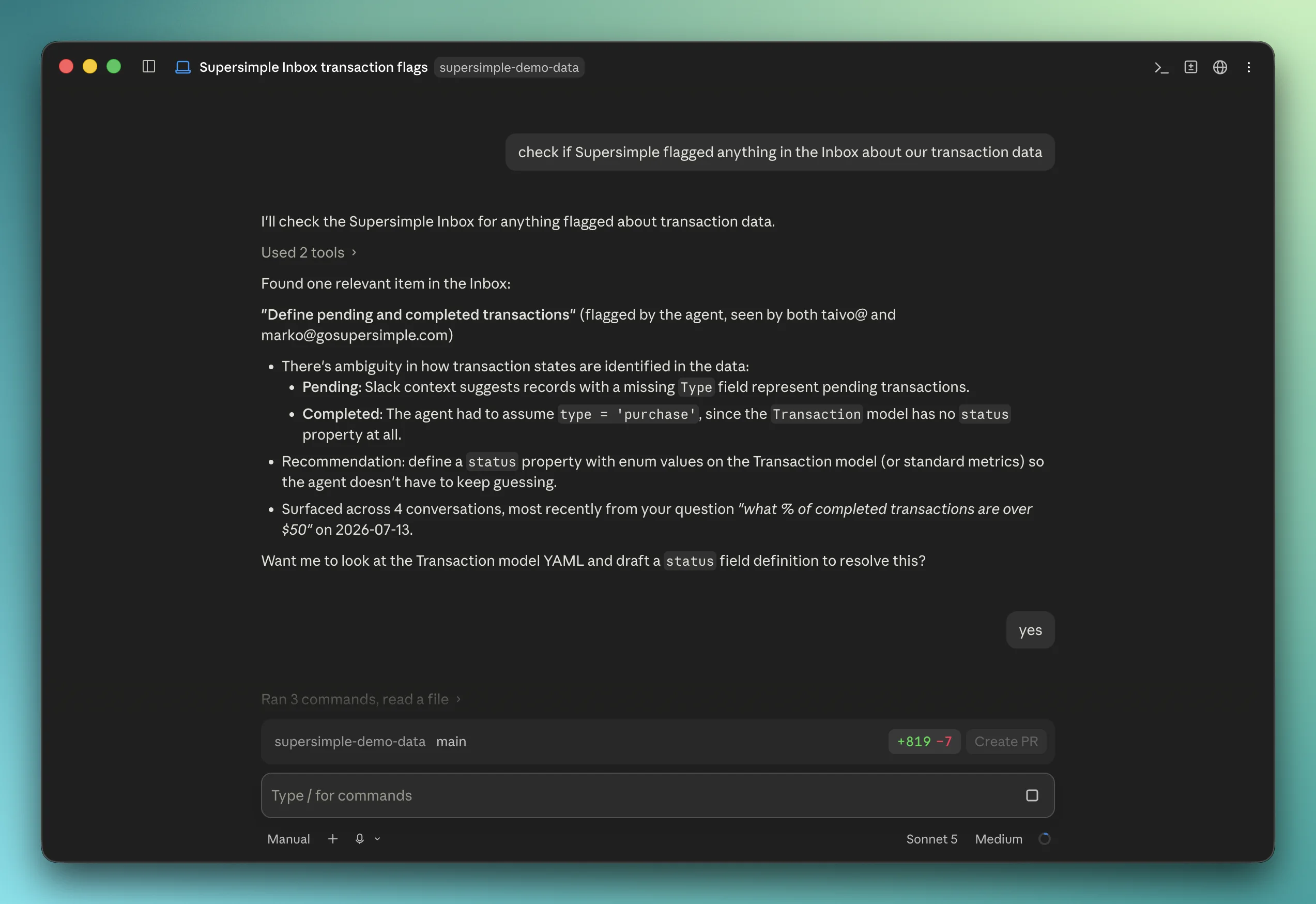
Supersimple gives data teams a centralized view of their team's analytical work.
Supersimple Inbox surfaces findings about missing or broken data, ambiguous definitions, conflicting context, and places where AI had to infer.
Items that need your attention or action
Users are asking about on-time delivery, but the model does not define the threshold or timezone to use.
Yes, especially for personal or one-off analysis. Claude can analyze uploaded data, execute code, create spreadsheets, charts, reports, and shareable interactive Artifacts. In supported Claude surfaces, live Artifacts can also become persistent dashboards connected to current data. What Claude does not provide by itself is a company-wide governed semantic layer, shared business definitions and permissions, explainable analytical operations, or a centralized way to improve the data stack from real usage. Supersimple provides that BI system and can be used on its own or together with Claude.
Yes. Claude can connect to Supersimple's MCP server which gives it tooling to pass analytical questions to Supersimple's AI, as well as manage your data models and usage data.
No. Supersimple is a complete enterprise-grade AI platform for asking questions, exploring data, building reports, creating dashboards, and monitoring important changes. Tools like Claude, Cursor, ChatGPT, and Slack are additional places where people can start when those interfaces feel more natural.
Not necessarily. Teams can use Supersimple on its own, or combine it with Claude. The same governed context, permissions, explainable execution, and improvement workflow can support questions that begin in Supersimple, Claude, or Slack.
Claude alone can be a good fit for personal, one-off work with a bounded dataset when the person asking can provide the context and verify the result. Supersimple becomes more valuable when answers are shared, repeated, permission-sensitive, expected to use common definitions, or need to become maintained analytical assets.
No. Inbox surfaces recurring gaps with evidence from the questions that exposed them. A data owner decides whether and how data, a model, metric, relationship, source, instruction, or skill should change.
The same governed analytical foundation supports both, so people can choose the interface that fits the work in front of them.